


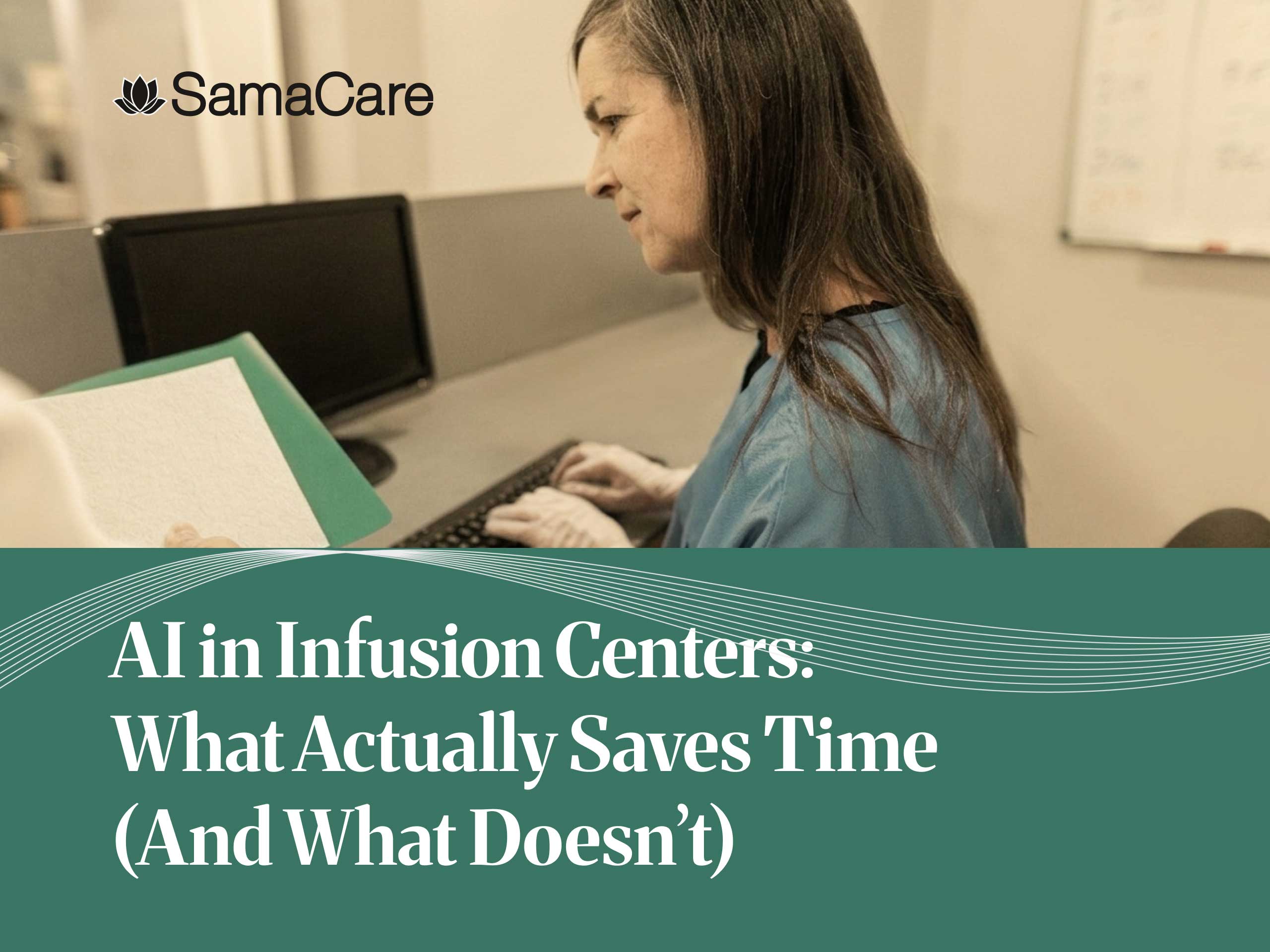
Artificial intelligence is quickly becoming part of the conversation in infusion center operations. From prior authorization to scheduling to documentation, there’s growing interest in how AI might reduce administrative burden and improve patient access to care.
For infusion centers, the question isn’t whether AI is promising. It’s whether it actually saves time in day-to-day workflows.
In practice, the answer depends less on the technology itself and more on how it is applied.
Where AI Falls Short
Not all AI implementations meaningfully improve infusion workflows. In some cases, they can even introduce new friction.
One common issue is AI that adds steps instead of removing them. If staff still need to double-check outputs, re-enter data, or reconcile information across systems, the net time savings may be minimal. In already stretched environments, even small inefficiencies add up.
Another challenge is tools that sit outside of the core workflow. If AI requires users to move between systems, switch tabs, or manually transfer information into payer portals, it interrupts the flow of work rather than streamlining it. For infusion centers managing high volumes of prior authorizations, continuity matters.
AI can also fall short when it lacks real-world context. Prior authorization is not a standardized process. Requirements vary across payers, plans, and therapies, and many of those requirements are not clearly documented. Systems that rely only on static rules or limited datasets may miss the nuances that determine whether a submission is approved or denied.
Finally, there is the issue of trust. In clinical and administrative settings alike, staff need to understand and control the work they are responsible for. AI that functions without transparency into how recommendations are generated can be difficult to adopt, regardless of its capabilities.
What Actually Saves Time
In contrast, the most effective use of AI in infusion centers tends to share a few key characteristics.
First, it is embedded directly into the workflow. Instead of requiring additional tools or steps, AI operates within the systems staff are already using to manage prior authorizations. This reduces friction and allows teams to maintain focus on the task at hand.
Second, it removes repetitive administrative work. Prior authorization often involves entering the same information across multiple payer portals, tracking submission status, and following up on delays. AI can help automate these steps, freeing up staff time for higher-value activities.
Third, it provides guidance before submission. One of the biggest drivers of delays is incomplete or incorrect documentation. AI that surfaces relevant requirements, such as forms, supporting documentation, or known payer implicit expectations, can help staff submit stronger prior authorizations the first time.
Importantly, these systems do not replace human judgment. Instead, they support it. Staff remain in control of each submission, reviewing and approving information before it is sent. The role of AI is to reduce the manual burden and surface insights, not to make decisions independently.
The Impact on Infusion Center Operations
Prior authorization continues to be a significant administrative burden across healthcare, with physicians reporting that it delays patient care and requires substantial staff time¹, and contributes to operational inefficiencies across practices.²
When implemented effectively, these capabilities can have a measurable impact on infusion center prior authorization management.
Teams are able to handle higher volumes of prior authorizations without increasing staffing levels. Administrative workload is reduced, allowing clinicians and staff to focus more time on patient care. Most importantly, patients are able to start physician-prescribed therapy sooner.
As one infusion center administrator described:
“That experience [with AI] was seamless and amazing. In the time it used to take me to submit a single PA, I was able to submit five.”
Experiences like this highlight an important point: time savings in prior authorization are not just operational improvements. They directly affect patient access to treatment.
Moving Forward
AI will continue to evolve, and its role in infusion center operations will likely expand. But the most important question for any organization evaluating new tools remains the same:
Does this improve process efficiency, patient experience, and patient outcomes?
For infusion centers, the answer depends on whether AI reduces steps, integrates into existing workflows, reflects real-world complexity, and keeps staff in control.
When those conditions are met, AI can become a practical tool for improving efficiency, reducing administrative burden, and helping patients access care without unnecessary delays.
References
¹ American Medical Association. Prior Authorization Physician Survey.
https://www.ama-assn.org/system/files/prior-authorization-survey.pdf
² Medical Group Management Association. https://www.mgma.com/articles/the-prior-authorization-landscape-in-2025
About the Author
SamaCare is a healthcare technology company dedicated to simplifying prior authorization and improving patient access to provider-administered medications. By streamlining complex workflows, SamaCare supports infusion centers and specialty practices in delivering timely, efficient, and high-quality care.