



Practical Revenue Cycle, Operational, and Patient Care Strategies for Today’s Independent Infusion Centers
If you lead, manage, or deliver infusion therapy today, you are witnessing one of the most significant shifts in healthcare delivery over the last decade: infusion care is rapidly moving out of hospitals and into community-based and independent infusion centers.
This transition is not simply about reducing costs. It is about improving patient access, increasing convenience, preserving healthcare resources, and delivering high-quality care in the most appropriate setting. Payers, employers, providers, and patients are all driving this movement, creating both tremendous opportunities and new operational challenges for infusion providers.
For independent infusion centers and ambulatory infusion suites, the question is no longer whether this migration will continue. The question is whether your organization is prepared.
Why the Shift Is Happening
Historically, many infusion therapies were administered in Hospital Outpatient Departments (HOPDs) because hospitals were viewed as the safest environment for specialty medications and complex patient populations.
Over time, however, clinical evidence has demonstrated that many infusion therapies can be administered safely and effectively in alternative settings, including physician offices, independent infusion centers, and home infusion programs.
At the same time, healthcare costs have become a growing concern for payers, employers, and patients. Hospital outpatient reimbursement rates often exceed those of community-based settings by a substantial margin, even when clinical outcomes are comparable.
Recent studies continue to demonstrate that patients receiving infusion therapy in alternative sites of care experience similar clinical outcomes, emergency department utilization, and hospitalization rates compared to those treated in hospital outpatient departments, while generating significantly lower overall healthcare costs.
As a result, payers are increasingly directing patients toward lower-cost sites of care, whenever clinically appropriate.
Independent Infusion Centers Are Becoming the Preferred Site of Care
Across the country, independent infusion centers are emerging as the preferred destination for many specialty therapies.
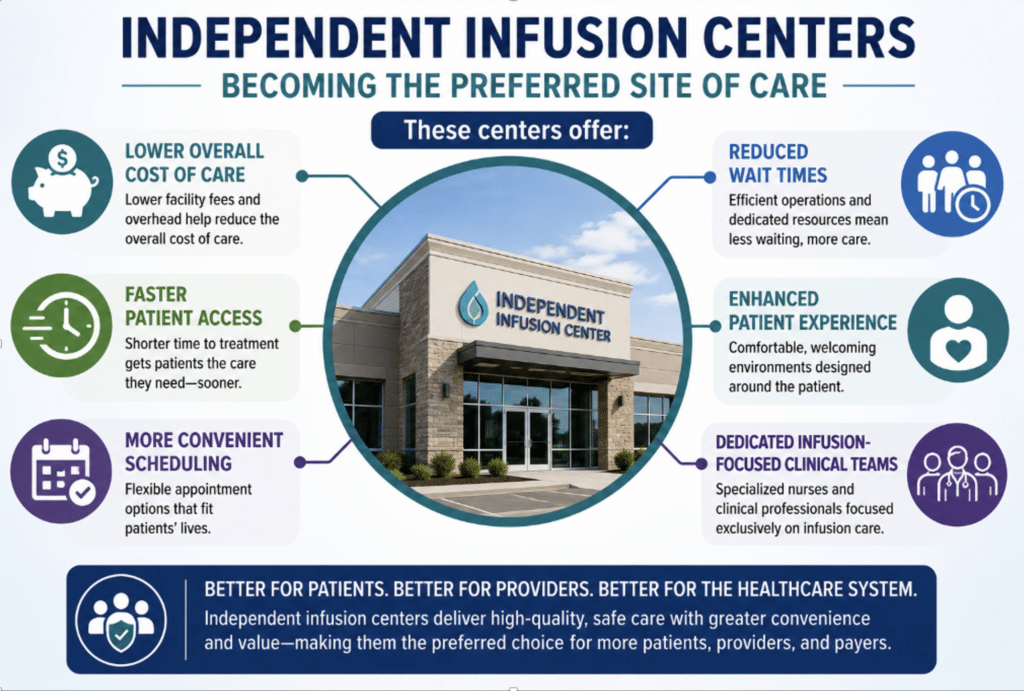
For many patients, receiving treatment in a community-based infusion center means avoiding crowded hospital campuses, expensive facility fees, and lengthy appointment delays.
For providers, it creates an opportunity to maintain continuity of care while improving operational efficiency.
For payers, it offers meaningful cost savings without sacrificing quality.
The result is a healthcare environment increasingly aligned around independent infusion delivery.
Therapies Driving the Migration
Many therapies that were once routinely administered in hospitals are now being redirected to independent infusion centers.
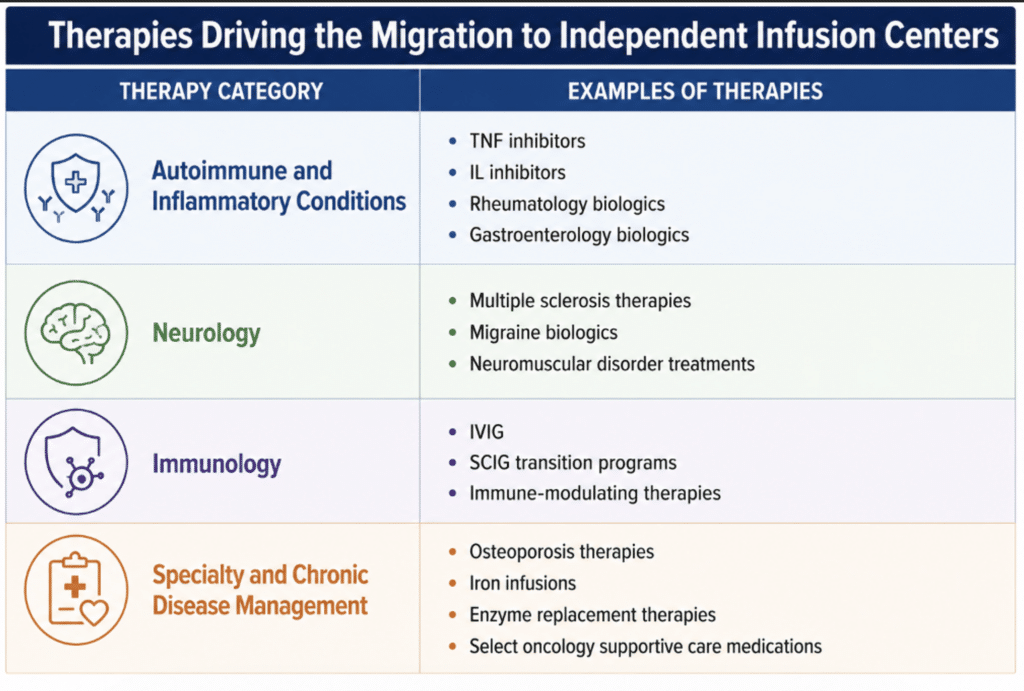
Studies comparing hospital outpatient settings and non-hospital outpatient settings have shown similar or improved safety outcomes in many of these therapy categories, further supporting payer migration strategies.
Hospital-Based Infusion Is Still Essential for Certain Patients
While the migration toward community-based care continues, hospitals remain critical for patients requiring advanced monitoring and higher-acuity services.
Examples include:
- CAR-T therapy
- Complex chemotherapy regimens
- High-risk biologics
- Patients with significant infusion reaction histories
- Patients requiring intensive multidisciplinary support
The future is not about replacing hospitals.
It is about ensuring that each patient receives care in the most clinically appropriate setting while reserving hospital resources for those who truly need them.
Revenue Cycle Implications of the Migration
As patient volume shifts into independent infusion centers, revenue cycle performance becomes increasingly important.
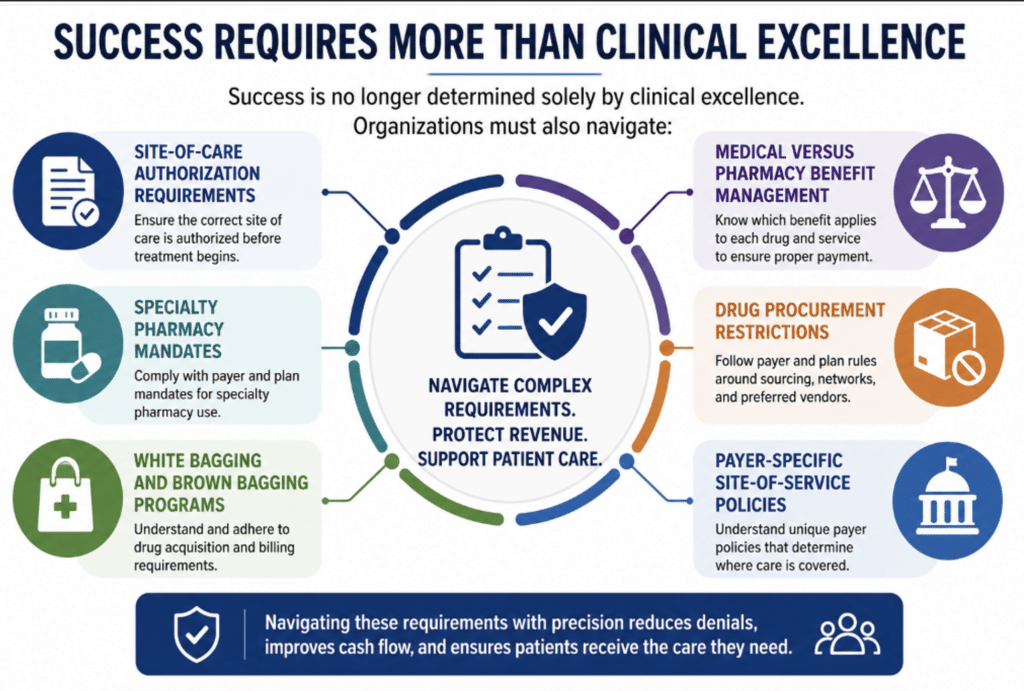
Failure to align operational workflows with these requirements can lead to:
- Authorization denials
- Claim rejections
- Payment delays
- Retroactive recoupments
- Patient treatment interruptions
The most successful infusion centers are building revenue cycle processes that identify site-of-care requirements before treatment begins rather than after a denial occurs.
Operational Readiness for Growth
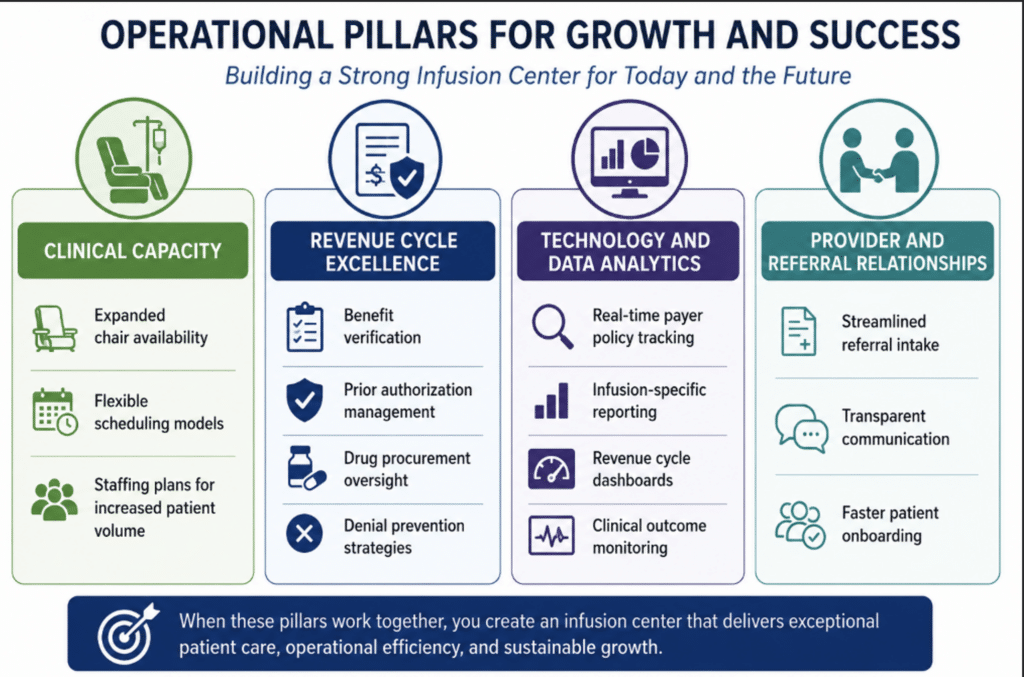
Independent infusion centers positioned for growth are investing in infrastructure now.
Key areas of focus include:
Patient Experience Will Differentiate Winners
As more infusion centers enter the market, patient experience will become a critical differentiator.
Patients increasingly value:
- Convenient locations
- Flexible appointment times
- Comfortable treatment environments
- Consistent communication
- Financial transparency
Independent infusion centers often have a unique advantage because they can deliver highly personalized care while maintaining operational efficiency.
When patients have a positive experience, providers are more likely to refer, payers are more likely to partner, and organizations are more likely to grow.
The Future of Infusion Care
The infusion industry is experiencing a fundamental transformation.
The healthcare system is steadily moving away from the assumption that hospitals should be the default setting for infusion therapy. Instead, care is being delivered in the most clinically appropriate, cost-effective, and patient-centered environment possible.
Independent infusion centers are no longer simply an alternative site of care—they are increasingly becoming the preferred site of care for many therapies and patient populations.
Organizations that understand this shift and proactively invest in clinical excellence, operational readiness, revenue cycle optimization, and patient experience will be positioned to thrive in the years ahead.
The migration is already underway. The question for infusion providers is not whether change is coming, but whether they are prepared to lead it.
References
Advisory Board (2025) 4 major trends shaping today’s oncology market.
Aetna. (2026). Drug infusion/injection site of care policy. https://www.aetna.com/health-care-professionals/utilization-management/drug-infusion-site-of-care-policy.html
American Academy of Allergy Asthma and Immunology. Guidelines for the site of care for administration of IGIV therapy. (December 2011) https://www.aaaai.org/Aaaai/media/Media-Library-PDFs/Practice%20Management/Practice%20Tools/Guidelines-for-the-site-of-care-for-administration-of-IGIV-therapy.pdf
American Society of Health-System Pharmacists. (n.d.). Navigating and optimizing infusion services when hospital-based care is not an option. https://www.ashp.org/-/media/assets/practice-management/docs/Site-ofCare-Challenges-81919.pdf
Centers for Medicare & Medicaid Services. (2026). Place of service codes. https://www.cms.gov/medicare/coding-billing/place-of-service-codes/code-sets
Chang, J., Sen, A. (2023). Rising share of chemotherapy services provided in outpatient departments is associated with higher costs for patients and payers. Health Care Cost Institute. Healthcare Cost and Utilization Studies. https://healthcostinstitute.org/all-hcci-reports/rising-share-of-chemotherapy-services-provided-in-outpatient-departments-is-associated-with-higher-costs-for-patients-and-payers/
Cullen, D., Gordon, A. S., Adkins Svoboda, S., Alvarez, M., & Cobb, R. (2026). Infusion therapy patient outcomes are similar at reduced costs in alternative sites of care compared with hospital outpatient departments: A matched cohort analysis of infusion therapy across multiple chronic conditions. Journal of Managed Care & Specialty Pharmacy, 32(2), 1–11. https://doi.org/10.18553/jmcp.2025.25264
Raj, L., Stinson, G., Langsam, J., & DeMacio, J. (2025). Comparison of Specialty Injection and Infusion Adverse Events Among Hospital Outpatient Settings vs Non-Hospital Outpatient Settings. Journal of Clinical Pathways, 11. https://doi.org/10.25270/jcp.2025.11.01
United Healthcare (January 2026). Provider Administered Drugs – Site of Service https://www.uhcprovider.com/content/dam/provider/docs/public/policies/comm-medical-drug/provider-administered-drugs-soc.pdf
About the Author
Kelly Kish-Newman is a nationally recognized oncology nursing and infusion services leader with more than three decades of clinical, operational, and executive experience. She holds both a BSN and MS in Nursing from the University of Arizona. Kelly currently serves as President of OCInfusion, Sunshine Billing, and Oncology Convergence, where she focuses on advancing infusion center performance, reimbursement strategy, and sustainable practice operations nationwide. Her career spans bedside medical oncology and bone marrow transplant nursing, academic instruction, executive leadership, and national speaking engagements on infusion care delivery and revenue cycle optimization.
Social Media Links
https://www.linkedin.com/in/kelly-kish-a9a44654