



There’s much at stake if you are directly or indirectly responsible for moving medications from the manufacturer to a patient. Bryan Johnson goes in depth about the DSCSA and leveraging barcodes that are a part of everyday operations in the healthcare supply chain.
For most of us who have embraced the self-checkout option at our local grocery store, barcodes are something we understand at a basic level. I don’t believe the average person moving a product across the laser is aware of the technology powering this process, but we all perceive that some kind of magic is happening to help the checkout machine know the difference between a bag of spicy nacho cheese Doritos and a gallon of milk.If you or your team are involved in one of the many healthcare supply chain markets and you are directly or indirectly responsible for moving medications from the manufacturer to a patient, then there is much more at stake in your world than your groceries.
Before we begin demystifying barcodes for medications, we need to understand why these barcodes appear on our medications in the first place. For the purpose of this article, we are talking about the 2D GS1 Datamatrix barcodes that appear on medications as a result of the Drug Supply Chain Security Act.
What is the DSCSA?
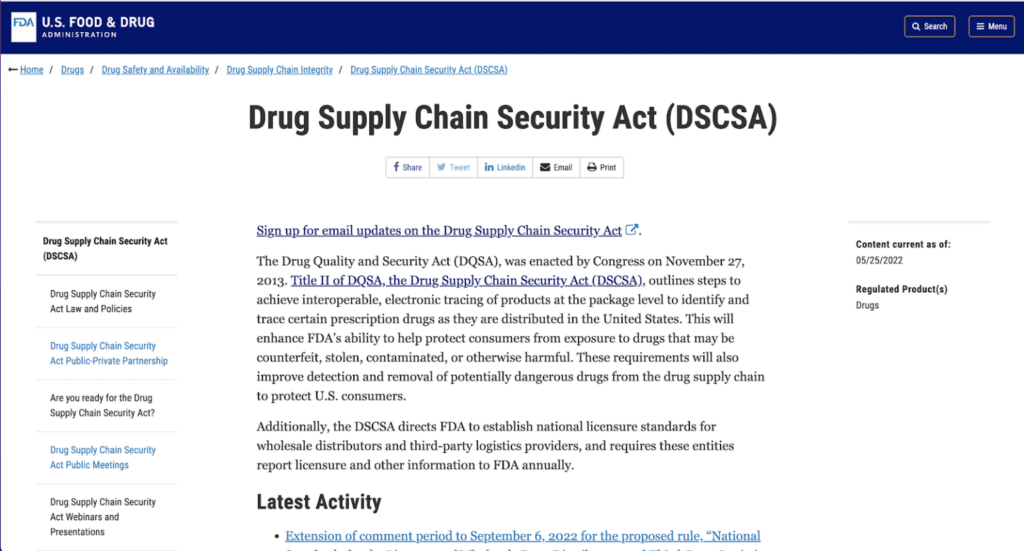
The Drug Supply Chain Security Act (DCSCA) is part of the Drug Quality and Security Act (DQSA), enacted by Congress on November 27, 2013. Title II of the DQSA, the Drug Supply Chain Security Act (DSCSA), outlines steps to achieve interoperable, electronic tracing of products at the package level to identify and trace certain prescription drugs as they are distributed in the United States. If you have heard of the phrase “track and trace” before, this is where that reference comes from.
“The DSCSA was enacted in 2013 to further secure our nation’s drug supply. It creates a tighter, closed prescription drug distribution system to prevent harmful drugs from entering the supply chain, harmful drugs if they do enter the supply chain, and enable rapid response when such drugs are found.”
In summary, the DQSA was an act of Congress that created the DSCSA and many other new regulations. The act laid out a multi-year implementation plan with various milestones along its timeline. We are now coming up on one of the last deadlines of DSCSA, which is full system interoperability for unit-level tracing by November 2023. You can read all about it on the FDA’s webpage and we will link to additional resources as we go.